Author: Amy

  • Bitcoin is at 80k Range, Is It a Good Time to Buy?

    Bitcoin is at 80k Range, Is It a Good Time to Buy?

    Here it is again – that familiar knot in my stomach when Bitcoin’s chart looks like a ski slope. I’ve been here before: researching about bitcoin in 2017 in the living room of our San Diego apartment, when everybody suddenly started talking about it for the first time – $3k sure felt like a steal in hindsight, but at the time, it was “too risky.”  

    Now, after plunging from $126K highs in October to a seven-month low around $80K last week, BTC is rebounding slightly to ~$87K as of November 26, 2025. (For real-time checks, it’s hovering between $86.7K-$88.2K today, per exchange data.) I find myself once again researching about bitcoin and wondering – is it a good time to buy?

    Skeptical – I’m nervous about FOMO-ing in late, haunted by the constant “what if it drops more?” Yet the believers (especially the institutional ones) are piling in, treating this 30%+ correction like a fire sale. There’s no doubt Bitcoin has become almost too big to fail, even though the wild volatility still undermines its “digital gold” image.

    If this dip is my entry point, the real question is: how much should I actually buy?

    • If I put in too little – say $1,000 – and Bitcoin eventually hits $1 million (roughly 10× from today), that turns into about $10,000. A nice gain, sure, but nothing life-changing.
    • If I go too big – say $10,000 – and Bitcoin crashes back to $10k, I’m looking at a painful 90%+ loss.

    So I’m stuck: scared to miss the rocket, but terrified of catching the falling knife.

    I did have a really close call just recently.

    Just a month ago, when Bitcoin was hitting $120K highs, I was desperately trying to convince my husband to buy two whole coins. “Analysts say it’ll be $1 million in a few years”, I said. He refused. To keep the wifey happy, he did put in $5,000… which has since dropped about 25% (we laugh about it now so he can tease me).

    Honestly? Thank goodness for his stubbornness this time. 😅

    Bitcoin is Faith.

    I envy the believers. My friends who bought Bitcoin early and never sold (through the crashes, the bans, the “dead coin” obituaries) are now millionaires. I watched from the sidelines, always too cautious, always waiting for one more confirmation, one more dip, one more sign that it was “safe.” I was the one who thought $3K was expensive in 2017 and $19K was the top in 2021. Every time I hesitated, I told myself I was being prudent. Slow and steady wins the race, right?

    Except slow and steady could also mean missing the race entirely.

    Here’s the cruel irony: while I chose to invest more in the “safer” index funds (the S&P 500 and the like) and rode that wave without flinching, the voices calling AI a bubble are growing louder every day. After all, AI stocks alone have accounted for roughly 11-12% of the index’s 15-16% YTD gain – meaning they’ve driven about 75% of the S&P 500’s total return this year.

    We’re not buying earnings anymore. We’re buying a story about a future that hasn’t arrived yet. Expectations, not profits. Hopes, not revenue.

    Sound familiar?

    If I can suspend disbelief for the Artificial General Intelligence (AGI) that doesn’t exist yet, why can’t I do the same for a decentralized digital currency that is supposedly the digital gold? Both are bets on an automated, digitized tomorrow. Both are narratives sold by visionaries and bought by believers. The only difference is the story I’m willing to tell myself.

    Bitcoin is faith. AI is also faith.

    Maybe the real moral isn’t “slow and steady wins the race.” Maybe it’s “pick a damn race and run.”

  • 9 Secret Cash Back Sites That Pay You Up to 40% Extra on Black Friday 2025

    9 Secret Cash Back Sites That Pay You Up to 40% Extra on Black Friday 2025

    Before you hit “checkout” on your cart, stop and think twice. If you’re still shopping in 2025 without using a cash back site, you’re leaving hundreds of dollars on the table.

    Black Friday is already packed with massive deals — the best time of the year to shop — but stacking cash back on top literally makes a world of difference. These sites can turn your Black Friday haul 20–40% cheaper without any extra effort.

    In this article, I’m sharing the 9 best cash back sites and apps that deliver the highest real savings in 2025. Most pay you through PayPal, Venmo, direct deposit, or gift cards once you reach a tiny minimum (usually just $5–$20). Here are the top 9, ranked by reliability, payout speed, and how much extra cash you’ll actually pocket. (Pro Tip: compare cash back rates on different websites before you make the purchase.)

    These websites focus on “cash” back. If extra rewards are your bread and butter, stay tuned for the next article on the top shopping portals/rewards programs in 2025 that pay you in extra points/miles instead of straight cash back.

    1. Rakuten (the undisputed king)

    • Partners: 3,500+ stores (Macy’s, Walmart, Nike, Apple, etc.)
    • Typical cash back: 1–15%, spikes to 20–40% on Black Friday
    • How you get paid: Big fat check or PayPal every 3 months (they literally mail you a check if you want)
    • Why it’s great: Highest double-cash-back events of the year, foolproof browser extension, and a $40 welcome bonus after your first $40 spent.

    2. TopCashback (highest rates, zero catch)

    • Partners: 7,000+ stores including Apple, Samsung, Adidas
    • Typical cash back: Often 1–3% higher than Rakuten on the same stores
    • How you get paid: No minimum for PayPal, ACH, or gift cards – cash out $0.01 if you want
    • Why it’s great: Passes 100% of the commission to you (most sites keep a cut), making it the highest-paying portal in the U.S.

    3. Capital One Shopping (set-it-and-forget-it)

    • Partners: 30,000+ sites including Amazon, Target, Best Buy
    • Typical cash back: 1-15% + auto-applies coupons
    • How you get paid: Gift cards or statement credits
    • Why it’s great: Free browser extension works in the background, finds better prices, and stacks with your credit card rewards.

    4. Honey (now part of PayPal)

    • Partners: 40,000+ stores
    • Typical cash back: Honey Gold points → redeem for gift cards
    • How you get paid: Gift cards (Amazon, Walmart, Target, etc.)
    • Why it’s great: Automatically tests every coupon code at checkout + quietly earns you Gold points that turn into free money.

    5. RetailMeNot

    • Partners: 20,000+ stores + huge Black Friday “Cash Back Day” boosts
    • Typical cash back: 2–20%
    • How you get paid: PayPal or Venmo (usually within 45 days)
    • Why it’s great: Massive coupon library + legit cash back that often jumps 10–20% during November events.

    6. Ibotta (grocery + online hybrid beast)

    • Partners: Walmart, Target, Best Buy, Sam’s Club, hundreds more
    • Typical cash back: 1-25% online, plus any-receipt bonuses
    • How you get paid: PayPal, Venmo, or gift cards as soon as you hit $20 (often faster with bonuses)
    • Why it’s great: Works for online pickup/delivery orders and in-store – perfect for stacking on Black Friday grocery runs.

    7. BeFrugal (underrated gem)

    • Partners: 5,000+ stores
    • Typical cash back: 1–40% + exclusive coupons
    • How you get paid: PayPal, Venmo, check, or gift cards ($15 minimum)
    • Why it’s great: Frequently beats Rakuten and TopCashback by 1–5% and has a $20 sign-up bonus right now.

    8. Swagbucks (the all-in-one earner)

    • Partners: 10,000+ stores
    • Typical cash back: 1–12% in SB points
    • How you get paid: PayPal cash or gift cards (as low as $3)
    • Why it’s great: Shop + do quick surveys or watch videos to stack even more – people routinely cash out $50–$200/month.

    9. Fetch Rewards (receipt snapping simplicity)

    • Partners: Any online or in-store receipt (Walmart, Amazon, Target, etc.)
    • Typical cash back: 25-5,000+ points per receipt, plus brand-specific offers
    • How you get paid: Gift cards from $3
    • Why it’s great: Just snap your Amazon or Walmart receipt and get points even if you forgot to click through a portal – the ultimate safety net.

    Pro Move for Black Friday 2025

    Use CashbackMonitor.com or the browser extension “Cashback Tracker” before every purchase – it instantly shows which of the 9 sites above is paying the highest rate for that exact store in real time. Stack that with a cash-back credit card and you’re looking at 10–50% off everything.

    Start with Rakuten or TopCashback for pure online shopping, add Capital One Shopping extension for autopilot, and throw Ibotta or Fetch on top for receipts. Do that this Black Friday and you’ll literally get paid hundreds just for shopping like normal.

    Happy stacking – your wallet will thank you!

  • My Husband and I never fight about money – here are our secrets

    My Husband and I never fight about money – here are our secrets

    Money can be a major tension point for many couples. A 2023 survey by Suntrust Bank found that 54% of people believe that having a partner in debt could be a reason for a divorce. Another Fidelity’s 2024 Couples and Money Study shows that 45% of partners say they argue about money at least occasionally, and over one-quarter list money as their biggest relationship challenge. Money can be a sensitive and stressful topic between couples, which is why it’s even more important to set the ground rules before you chart the course of marriage.

    As Aries and Cancer, we bicker about the most ridiculous things, but we’re always on the same page with money. Here are a few of our “secrets” that I’d like to share with you.

    We follow the $50 rule

    In the very early days of our relationship, my husband (then boyfriend) shared an article with me about something called the “$50 rule.” The gist was simple: this couple would let each other know before making any purchase over $50. Of course, there were exceptions – gifts and surprises didn’t count, though they kept those reasonable too.

    I’ll admit, when we were dating, I was the bigger spender (not dramatically, just… noticeably😅). In hindsight, that’s probably why he shared this article with me, haha… and we both willingly started following this rule. Over time, this little rule laid a strong foundation for our relationship and marriage, and I’m genuinely grateful we started it early.

    Ten years have passed since we first set our $50 rule. Has the world gotten more expensive? Absolutely — even the $8 pho in Philly has more than doubled. Are we changing the rule? Absolutely not. It’s become second nature at this point, and we love it that way.

    We are aligned on “wants” vs “needs”

    We try hard to distinguish between “wants” and “needs.” It keeps our spending intentional and our goals aligned. This was another concept my husband introduced back when we were dating – which, when I say it out loud, wow, really makes me wonder just how reckless he thought I was with my spending at the time… Hold on, where is he? I’ll be right back…🤣

    I actually miss those days when so many “wants” we couldn’t afford would end up on our Christmas wishlist. While I’m grateful for how far we’ve come financially and how it’s easier for us to have occasional treats, celebrating Christmas or anniversaries somehow feels a lot trickier these days. Is it because we’re no longer broke students and have become parents, or because our wants now come with a bigger price tag (cough, cough, dream house)?

    Our accounts are shared

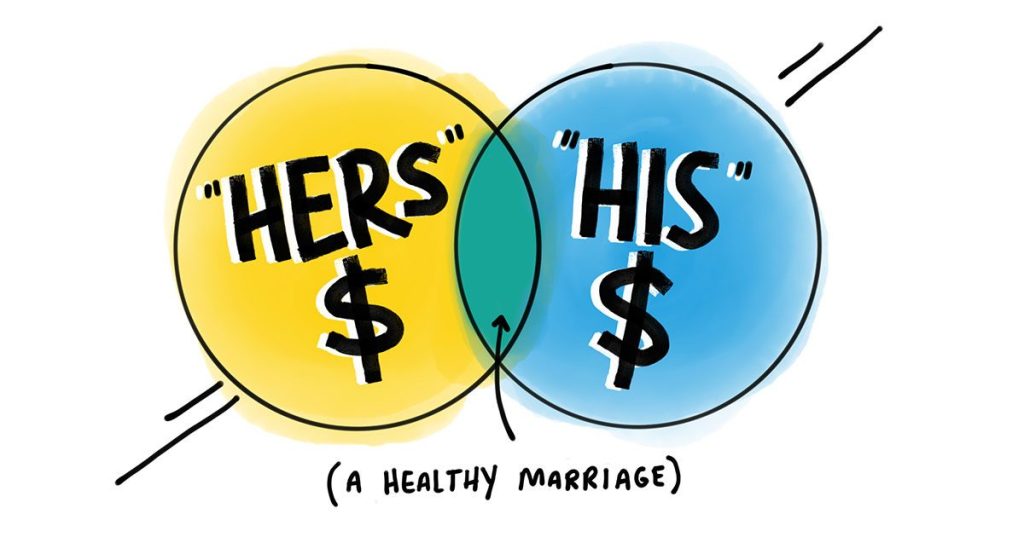
    We’re sharing our lives, so sharing our finances was a natural step. It keeps us aligned, transparent, and moving in the same direction. We love how we work so well as a team, and because we don’t really have stressful arguments about money, our love for each other blossoms even more over time.

    We use Empower (formerly Personal Capital) to track all of our accounts. It’s completely free, or at least we use the free version. You can link every category of your personal finances – credit cards, bank accounts, investment and retirement accounts, car loans, and mortgages, and the app or website gives you a complete view of your net worth, assets, and liabilities. Since we share all our accounts, there are no surprises that might cause a heart attack. Although… I’m still waiting for my husband to admit he has a secret stash of money somewhere. Wouldn’t that be nice? Don’t worry, babe, I promise I won’t be mad!😃

    Mutual respect = no power play

    No “I make more” energy, no scorekeeping. We value each other’s needs (and our families’ needs) equally – that’s real partnership. Every time we let each other know we’re about to make a purchase over (or way over) $50, the other person almost always says, “Sure, go ahead,” because the respect we have for each other comes with 100% trust.

    Once in a while, we have a dedicated conversation just about money. We review our current financial picture, income trajectory, investments, and the kids’ education fund. We also dream about the day when work becomes optional and we can FAT FIRE – that is, retire early while still living comfortably. Coming from humble backgrounds, these conversations bring us even closer.

    Every marriage is unique, and what works for ours might not work for yours. But one thing is clear: open communication, mutual respect, and shared financial goals can make a world of difference. What “secrets” or strategies for financial success in marriage have worked for you? We’d love to hear your insights and tips – let’s keep the conversation going!

  • What Motivates You to Save Money?

    What Motivates You to Save Money?

    Saving money is one of the most powerful steps toward building real wealth. While “saving” might sound dull or restrictive, it doesn’t have to be—especially when you have the right motivations behind it.

    A penny saved is a penny earned.

    I first came across this quote by Benjamin Franklin in my early twenties—though his original words were phrased a little differently. At the time, I had just finished grad school and was earning $45,000 a year. A pay raise felt like a distant dream. The only immediate way to see more money in my bank account was simple: save what I earned.

    But here’s the thing—our brains don’t naturally want us to save. There’s science behind that. We’re hardwired for comfort and instant gratification, not for delayed rewards. Corporations understand this all too well. They make spending frictionless: one-click checkouts, instant payment systems, and same-day delivery—all designed to help you part with your money effortlessly.

    As a twenty-something, of course I loved shopping too. I spent many afternoons walking through Center City Philly, browsing boutique stores on my days off. Luckily, Ben Franklin’s quote kept me in check and helped me build a habit of saving early on. I did plenty of window shopping and stayed up to date on fashion trends, but I learned to pause before buying. Every time I stopped to ask myself, “Do I need this, or do I just want it?”—I was training my financial discipline.

    And here’s a small but important tip: if you buy something new and change your mind after a few days, return it. It might sound obvious, but you’d be surprised how many people let new purchases sit unused, tags still on, until it’s too late. Taking advantage of return policies isn’t just about getting your money back—it’s about respecting the value of your hard-earned cash.

    As James Clear once said in his book Atomic Habits, “You should be far more concerned with your current trajectory than with your current results.” That mindset kept me going. Even when my savings seemed small, I knew I was moving in the right direction.

    More money saved = more can be invested.

    Albert Einstein once said, “compound interest is the eighth wonder of the world”. He wasn’t exaggerating. If you save $500 a month, that adds up to $6,000 a year—or $180,000 over 30 years.

    But here’s where it gets exciting: if you take that same $500 each month and invest it in a mutual fund averaging a 10% annual return, after 30 years you’d have $986,964—almost a million dollars! That’s the magic of compounding.

    Understanding how money saved and invested can snowball over time is one of my biggest motivations to save. Each dollar set aside isn’t just a dollar—it’s the seed of future growth. Knowing that if I choose not to spend a $20 bill today, it could become $25 just a few years later (at a 10% return, that’s about 2 years and 4 months) keeps me encouraged to save more—and to start now.

    Looking back, I’m grateful I learned the value of saving early. In my twenties, it wasn’t always easy to say no to things I wanted in the moment, but those small decisions added up. Each time I chose to save instead of spend, I wasn’t just growing my bank balance—I was shaping my mindset. Over time, saving stopped feeling like a restriction and started feeling like empowerment. It gave me confidence, freedom, and a sense of control over my future. And even now, years later, that same motivation—the one that started with a simple Ben Franklin quote—still reminds me that every dollar I choose to keep is a quiet investment in my future self.

    What motivates you to save? Share your thoughts in the comments—I’d love to hear your story.

  • Where We Began

    Where We Began

    The Februaries in Philadelphia are usually cold, and the one in 2015 was no different. When Tae and I met, we were both graduate students in our twenties—driven, ambitious, and still figuring out adulthood together. We shared a love for hard work and responsibility, yet our personalities and interests couldn’t have been more opposite. Maybe that’s what drew us together even more. We fell quickly and deeply in love, soon realizing that our differences weren’t obstacles but lessons—an ongoing journey of learning and growing through each other.

    When we began our life together in a tiny one-bedroom apartment in West Philly, it felt like the start of something hopeful and new. I had just started my first full-time job, earning $45,000 a year, while Tae was still finishing school and living on a modest military stipend. Between my entry-level salary and his small allowance, money was tight, and even though we tried our best to avoid it, credit card debt quietly found its way into our lives.

    There were stressful moments, like the day Tae’s old Android phone slipped out of his pocket and the screen cracked. I remember how frustrated he was—not because of the phone itself, but because fixing it meant another expense we couldn’t really afford. But there were also happy moments, like when he spent weeks searching for my first car—a $5,000 silver 2007 Honda Fit with one previous owner and a clean title. I had never seen that many scratches on a bumper, but I had never been happier driving that little car to my first real job.

    Through it all, we learned to laugh at ourselves and make the most of what we had. One evening, on the SEPTA bus ride back to West Philly, Tae pointed out that according to our budget tracking app, our biggest expense was food, and he suggested we should eat out less (even though we already didn’t eat out much). I told him that according to Engel’s Law, as household income rises, the proportion spent on food falls—in other words, food was our biggest expense simply because we were poor. He laughed, “Well, now we feel great about ourselves.” And we both did.

    We were rich in love, but not much else. Neither of us came from money, and even when Tae was stressed about his board exam upon graduation, there was no financial help from family. In those days, when we had more dreams than dollars, a few simple things laid the foundation for the partnership we still rely on today. We agreed to tell each other whenever we were about to make a purchase over $50—except for the occasional gift or surprise. We made a habit of distinguishing needs from wants, determined to make every dollar count. We worked hard, knowing that financial stability was something neither of us had growing up, yet both of us longed for as we built a new life together.

    For our younger selves, the idea of building a life in Hawaii one day would have felt like a distant dream. Yet here we are—10 years later—taking small, steady steps toward that vision. Every dollar saved, every lesson learned, and every challenge overcome has brought us closer to the life we once only imagined. As I start this blog to document our journey toward that dream, I hope our story reminds you that even humble beginnings can grow into something beautiful. I invite you to follow along as we continue to earn, save, and invest—one day, one goal, and one dream at a time.

  • Paying for Kids’ Education: 529 Basics You Need to Know

    Paying for Kids’ Education: 529 Basics You Need to Know

    My husband and I opened a 529 account for our son soon after his birth. Like many parents, we dream of him earning a full-ride college scholarship, but we’re realists at heart. Planning for his education means setting up a solid financial foundation now. That’s why we chose a 529 plan, drawn to its powerful tax benefits: tax-deferred growth and tax-free withdrawals for qualified expenses like tuition, books, and room and board.

    We also explored prepaid tuition plans, which let you lock in today’s tuition rates for future attendance at select colleges—a smart option worth considering. Ultimately, we chose a 529 investment account for its unbeatable benefits: tax-deferred growth, tax-free withdrawals for qualified expenses like tuition and books, flexible investment choices, and versatile withdrawal options. 

    Why should you look into a 529 Plan?

    With the rising costs of higher education and many Americans burdened by student debt, parents are increasingly using 529 savings plans, which offer tax benefits, to save for their children’s education. These plans, named after Section 529 of the Internal Revenue Code, were initially created to help cover college and other postsecondary education expenses.

    Tax Advantages

    • Investments in a 529 plan accumulate earnings without federal taxes (no taxes on gains or dividends) in the interim, enabling your savings to grow more rapidly through compounding since there’s no tax owed on ongoing investment returns or capital gains.
    • Withdrawals remain federally tax-free when applied to eligible education costs—such as tuition, textbooks, classroom materials, and housing and meals—although using funds for K-12 schooling could incur state taxes in some cases (check your state policy).
    • While contributions to a 529 are made with after-tax dollars so they’re not federally tax deductible, many states offer state income tax deductions on contributions or state tax exemptions on withdrawals if you invest in your own state’s 529 plan or if you live in a “tax parity state” (Arizona, Arkansas, Kansas, Maine, Minnesota, Missouri, Montana, Ohio or Pennsylvania) that allows you to deduct contributions to out-of-state plans as well.
    • In 2025, you can generally contribute up to $19,000 annually ($38,000 for couples) per beneficiary to one or more 529 college savings plans without triggering the federal gift tax. Alternatively, you can make a lump-sum contribution of up to $95,000 ($190,000 for couples) in a single year, treated as spread over five years for tax purposes, without incurring the federal gift tax.

    The Beneficiary Can Be Your Child, Your Grandchild, or Yourself

    • You can change the beneficiary to another child or family member if it turned out the original beneficiary doesn’t need the funds. As the account owner, you maintain control of the funds and have flexibility in how they are invested.
    • You can even open up a 529 account for yourself before you have children and later change the beneficiary to your child/children. The longer you have money invested in that 529 account, the longer period of time the investment can grow tax free.
    • Starting in 2024, you can roll over unused 529 funds into a Roth IRA tax- and penalty-free, but only to a Roth IRA owned by the same person who is the 529’s designated beneficiary. The 529 plan must also have been established for the beneficiary for at least 15 years before the transfer.

    Things to Watch Out For:

    • Don’t overfund your kids’ 529 plan(s). Withdrawals that are not for eligible education costs are subject to taxes plus a 10% penalty, with exceptions for certain circumstances, such as after death or disability. Utilize a compound interest calculator to project the growth and earnings of a 529 plan for a specific target year when college (or k-12) expenses are expected.
    • While the current federal law allow tax-free 529 withdrawals for K-12 tuition and certain expanded expenses (up to $10,000 per beneficiary per year in 2025, increasing to $20,000 in 2026), there are 11 non-conforming states that treat K-12 withdrawals as non-qualified distributions and will tax on earnings for k-12 withdrawals or even impose penalties. Review your state’s 529 plan rules to optimize your savings strategy and determine the most effective approach for your needs.

    Bottom Line:

    A 529 plan is a great estate-planning tool that could be used to save for education expenses while offering tax advantages and flexibility. For your child’s next birthday party, consider requesting contributions to their 529 education fund in lieu of traditional gifts to support their future academic goals.

    Have you started a 529 plan? Share your tips in the comments!

  • Credit Card Benefits for Military Personnel that May Surprise You

    Credit Card Benefits for Military Personnel that May Surprise You

    Active duty military personnel are entitled to many credit card benefits, thanks to the Servicemembers Civil Relief Act (SCRA) and Military Lending Act (MLA). In this article, we’ll explore some of the top credit card benefits for active-duty military personnel and their families that can provide the most value.

    1. Waived Annual Fees

    If you are an active duty military personnel, you may already know this: many of the credit card issuers like American Express, Chase, Citi, Bank of America, and US Bank would waive annual fees for you. Some banks, like Chase, automatically apply MLA benefits when they can verify eligibility through the DOD database. Other issuers, like Citi, may require you to submit a copy of your orders and a certificate from the MLA Database.

    One bank that’s slightly different is Capital One. While they also waive annual fees for your credit cards, these credit cards have to be opened before you became active duty. I have recently encouraged my brother-in-law to open up the Capital One Venture X Card, as he is about to join the military in a few months. Once he’s Active Duty, he’ll be able to enjoy this premium travel rewards card and its amazing perks while having the $395 annual fee waived.

    2. Fee Waivers Also Apply to Dependents of Active Duty Personnel

    Yes, spouses of active-duty personnel can have credit card fee waivers applied to their accounts as well. This includes premium credit cards with exclusive benefits and rewards, which typically carry significant annual fees. For example, the annual fee for the American Express Platinum Card has recently been increased to a whopping $895! Luckily, it’s waived for military personnel and their dependents.

    If you didn’t know this before and had annual fees charged to your accounts, you can also call the credit card issuer and they’ll likely waive the annual fee retroactively and apply the credit to your account.  

    3. Fee Waivers for Authorized Users too (You’re welcome, Mom!)

    Here’s a lesser-known benefit: active-duty personnel and their spouses can add authorized users, even those not affiliated with the military, and the annual fees for these authorized user cards are also waived.

    Take the American Express Platinum Card for example. Adding an Amex Platinum authorized user grants them many of the primary cardholder’s travel benefits, such as lounge access, elite hotel and car rental status, and a Global Entry or TSA PreCheck credit. Currently it costs $195 for each authorized user card, but luckily for you and your authorized user, that fee will be waived. Your mom can thank you later for the elite hotel status or lounge access, while using the luxury metal card as an authorized user.

    4. Annual Fees Waived For Multiple Cards

    Credit card issuers make this benefit seamless. Once your first card with a provider like American Express, Chase, or Citi has its annual fee waived, any additional cards you open with them will also have their fees waived automatically, without needing to contact the issuer or submit further paperwork.

    5. Waived Foreign Transaction Fees

    When deployed or with a copy of OCONUS PCS Orders, some banks will eliminate the foreign currency transaction fee on credit cards (and/or debit cards) (usually 1-2% of purchase price). Banks’ policies may vary so please contact your bank to learn more.

    6. Interest Rate Caps

    The average credit card interest rate (APR) is approximately 20.03% as of early October 2025, varying based on creditworthiness and card type. Military members have protections that can lower credit card interest rates through the Servicemembers Civil Relief Act (SCRA) and Military Lending Act (MLA).  The SCRA caps interest on pre-service debts at 6%, while the MLA caps interest on many active-duty loans at 36%. 

    Some issuers offer additional benefits that go above and beyond those required by law. Capital One and Chase offer a low APR with an interest cap of 4% on eligible balances during active duty and one year afterward. Since each issuer may handle military benefits differently, it’s always best to reach out directly with any questions or if you’re looking for specific details.

    If any of these benefits surprised you, look into them further—you might save significantly by taking advantage of these offerings!

  • Hello and Welcome!

    Hello and Welcome!

    Welcome to Course to Paradise!

    Aloha! I’m Amy, a military spouse and federal employee obsessed with mastering credit card points, investing wisely, and finding clever money-saving hacks—all to unlock financial freedom. My husband, an active-duty healthcare professional in the military, and I dream of moving to Hawaii to live a life of comfort and adventure in paradise. With Hawaii’s high cost of living, we’re strategizing hard to turn that dream into reality, and Course to Paradise is where we share every step of our financial journey.

    Over the years, friends have turned to me for advice on credit card rewards and money-saving hacks, urging me to start this blog. Now, I’m here to share practical tips, savvy strategies, and our progress toward a life in Hawaii. Whether you’re chasing your own financial goals or dreaming big, join us! Subscribe for weekly insights, follow me on X and Facebook, or share your favorite money tip in the comments.

    What’s your dream destination? Let’s chat in the comments!

  • 6 Tips to Lower Your Taxes

    6 Tips to Lower Your Taxes

    One of Benjamin Franklin’s most famous and often-cited quotes is, “In this world, nothing can be said to be certain except death and taxes.” While paying our fair share of taxes is essential to keep public schools funded, roads maintained, and parks and recreation services operating smoothly, it’s equally important to be smart about tax savings. By doing so, we can ensure that our hard-earned dollars help us maintain a higher quality of life. Here are some practical and legal tax-saving tips specifically for regular W-2 earners (employees who receive a paycheck with taxes withheld).

    1. Max Out Employer-Sponsored Retirement Accounts

    Retirement Accounts such as 401(k), 403(b), or TSP are some of the most effective ways to save on taxes while building long-term wealth. For any of these accounts, you can contribute either to a Traditional account or a Roth account. Take 401(k) as an example:

    Traditional 401k: A Tax Break Right Now

    Contributions are made with pre-tax dollars, which lowers your taxable income and reduces the amount of income tax you owe today. The money you invest then grows tax-deferred, meaning you don’t pay taxes each year on interest, dividends, or capital gains—allowing your savings to compound faster.

    Roth 401k: A Tax Break in Retirement

    While a traditional IRA offers an immediate tax deduction, a Roth IRA provides its benefits later—during retirement. Because contributions are made with after-tax dollars, both your investment growth and withdrawals are completely tax-free in retirement. This can be a major advantage for younger investors in their 20s or 30s, as it allows decades of potential tax-free compounding throughout their careers.

    Look into Employer Matching

    Many employers also match contributions, adding extra, tax-advantaged money to your account. In retirement, withdrawals are taxed at your ordinary income rate, which for many people is lower than during their working years, making the 401(k) a powerful tool for both tax savings and financial growth.

    2. Max out IRA

    Not everyone has a 401(k), but everyone can open up an IRA account. Similar to an employer-sponsored retirement account, you can elect to contribute either to a Traditional IRA or a Roth IRA, and your contributions will be tax deductibles. The amount you are eligible to contribute depends on factors such as your income level and whether you or your spouse are covered by a workplace retirement plan. For instance, in 2025 (for taxes filed in 2026), if you’re married filing jointly, covered by an employer plan, and your modified adjusted gross income is $146,000 or higher, your deduction may be limited or unavailable. Contribution limits also apply — for 2025, you can contribute up to $7,000 annually, or $8,000 if you’re age 50 or older. Additionally, you have until the tax filing deadline to make IRA contributions for the previous year, giving you extra flexibility to maximize your tax benefits.

    3. Take Advantage of Pre-Tax Benefits

    Health Savings Accounts (HSAs) and Flexible Spending Accounts (FSAs) both help you reduce your taxable income by putting money away for healthcare expenses. 

    Health Savings Account (HSA): Available if you have a high-deductible health plan.

    Contributions are tax-deductible, grow tax-free, and can be withdrawn tax-free for medical expenses. The HSA contribution limits for 2025 are $4,300 for self-only coverage and $8,550 for family coverage. Those 55 and older who are not enrolled in Medicare can contribute an additional $1,000 as a catch-up contribution.

    Flexible Spending Account (FSA): Use pre-tax dollars for medical or dependent care costs.

    Contributions are taken from your paychecks directly and put away in the FSA account, so you don’t pay taxes on them. The Health FSA contribution limits for 2025 are $3,300 per year, with a $660 rollover maximum. Dependent Care FSA contribution limits for 2025 are $5,000 per household (married filing jointly).

    4. Adjust Your Withholding

    The W-4 form is a form you fill out to tell your employer how much tax to withhold from each paycheck. Review your W-4 form each year or after major life changes (marriage, new baby, home purchase) to make sure you are withholding the right amount based on your tax estimates. You don’t want to over-withhold: while a big refund is nice, you would be giving IRS an interest-free loan while missing out time in investment. You also want to be careful and not under-withhold: you’ll end up with unexpected tax bill when you file your return and may be subject to an underpayment penalty.

    5. Look Into Tax Credits You May Qualify For

    Tax credits are one of the most powerful ways to reduce your tax bill because, unlike deductions (which lower your taxable income), credits directly reduce the amount of tax you owe — dollar for dollar. Popular tax credits include:

    Tax Credits for low-to-middle-income households

    Earned Income Tax Credit: The rules can get complex, but if you think you’ll earn less than $68,675 in 2025, the earned income tax credit might be worth looking into as it could get you up to $8,046 when you file in 2026.

    Premium tax credit is another refundable tax benefit that is worth looking into. It can help offset the cost of health insurance premiums from qualified health insurance marketplace plans.

    Child Tax Credit

    The child tax credit could get you up to $2,200 per kid, with $1,700 being potentially refundable through the additional child tax credit. You may qualify for the full credit only if your modified adjusted gross income is under:

    • $400,000 for those married filing jointly and $200,000 for all other filers.
    • The higher your income, the less you’ll qualify for.

    Lifetime Learning Credit

    The lifetime learning credit can get up to $2,000 (per return, not per student) for tuition, activity fees, books, supplies and equipment for undergraduate, graduate or even nondegree courses at accredited institutions.

    6. Kids’ 529 with Triple Tax Advantages

    While it would be everyone’s dream that their kids would get a full ride scholarship to their dream colleges, it would be wise to still plan realistically and take advantage of the tax benefits of 529 accounts.

    • While 529 contributions are after-tax dollars, some states offer state income tax deductions or credits for contributions to your kids’ 529 accounts. Check your state and see if there’s any tax incentive.
    • Contributions in 529 accounts grow tax-free – You won’t pay taxes each year on interest, dividends, or capital gains — the money compounds without any taxes.
    • Withdrawals are tax-free when used for qualified education expenses. This includes tuition, books, fees, supplies, and even room and board for college. You can also use up to $10,000 per year for k-12 tuition and up to $10,000 total toward student loan repayment. You can also change the beneficiary to another family member or even yourself without triggering taxes.

    A quick reminder: if you use 529 funds for non-qualified expenses, only the earnings portion (not your contributions) will be subject to income tax plus a 10% penalty. To plan wisely, it’s a good idea to use a compound interest calculator to estimate how much you’ll need to invest today to cover your child’s education costs when the time comes.