Tag: Investing

  • Bitcoin is at 80k Range, Is It a Good Time to Buy?

    Bitcoin is at 80k Range, Is It a Good Time to Buy?

    Here it is again – that familiar knot in my stomach when Bitcoin’s chart looks like a ski slope. I’ve been here before: researching about bitcoin in 2017 in the living room of our San Diego apartment, when everybody suddenly started talking about it for the first time – $3k sure felt like a steal in hindsight, but at the time, it was “too risky.”  

    Now, after plunging from $126K highs in October to a seven-month low around $80K last week, BTC is rebounding slightly to ~$87K as of November 26, 2025. (For real-time checks, it’s hovering between $86.7K-$88.2K today, per exchange data.) I find myself once again researching about bitcoin and wondering – is it a good time to buy?

    Skeptical – I’m nervous about FOMO-ing in late, haunted by the constant “what if it drops more?” Yet the believers (especially the institutional ones) are piling in, treating this 30%+ correction like a fire sale. There’s no doubt Bitcoin has become almost too big to fail, even though the wild volatility still undermines its “digital gold” image.

    If this dip is my entry point, the real question is: how much should I actually buy?

    • If I put in too little – say $1,000 – and Bitcoin eventually hits $1 million (roughly 10× from today), that turns into about $10,000. A nice gain, sure, but nothing life-changing.
    • If I go too big – say $10,000 – and Bitcoin crashes back to $10k, I’m looking at a painful 90%+ loss.

    So I’m stuck: scared to miss the rocket, but terrified of catching the falling knife.

    I did have a really close call just recently.

    Just a month ago, when Bitcoin was hitting $120K highs, I was desperately trying to convince my husband to buy two whole coins. “Analysts say it’ll be $1 million in a few years”, I said. He refused. To keep the wifey happy, he did put in $5,000… which has since dropped about 25% (we laugh about it now so he can tease me).

    Honestly? Thank goodness for his stubbornness this time. 😅

    Bitcoin is Faith.

    I envy the believers. My friends who bought Bitcoin early and never sold (through the crashes, the bans, the “dead coin” obituaries) are now millionaires. I watched from the sidelines, always too cautious, always waiting for one more confirmation, one more dip, one more sign that it was “safe.” I was the one who thought $3K was expensive in 2017 and $19K was the top in 2021. Every time I hesitated, I told myself I was being prudent. Slow and steady wins the race, right?

    Except slow and steady could also mean missing the race entirely.

    Here’s the cruel irony: while I chose to invest more in the “safer” index funds (the S&P 500 and the like) and rode that wave without flinching, the voices calling AI a bubble are growing louder every day. After all, AI stocks alone have accounted for roughly 11-12% of the index’s 15-16% YTD gain – meaning they’ve driven about 75% of the S&P 500’s total return this year.

    We’re not buying earnings anymore. We’re buying a story about a future that hasn’t arrived yet. Expectations, not profits. Hopes, not revenue.

    Sound familiar?

    If I can suspend disbelief for the Artificial General Intelligence (AGI) that doesn’t exist yet, why can’t I do the same for a decentralized digital currency that is supposedly the digital gold? Both are bets on an automated, digitized tomorrow. Both are narratives sold by visionaries and bought by believers. The only difference is the story I’m willing to tell myself.

    Bitcoin is faith. AI is also faith.

    Maybe the real moral isn’t “slow and steady wins the race.” Maybe it’s “pick a damn race and run.”

  • My Husband and I never fight about money – here are our secrets

    My Husband and I never fight about money – here are our secrets

    Money can be a major tension point for many couples. A 2023 survey by Suntrust Bank found that 54% of people believe that having a partner in debt could be a reason for a divorce. Another Fidelity’s 2024 Couples and Money Study shows that 45% of partners say they argue about money at least occasionally, and over one-quarter list money as their biggest relationship challenge. Money can be a sensitive and stressful topic between couples, which is why it’s even more important to set the ground rules before you chart the course of marriage.

    As Aries and Cancer, we bicker about the most ridiculous things, but we’re always on the same page with money. Here are a few of our “secrets” that I’d like to share with you.

    We follow the $50 rule

    In the very early days of our relationship, my husband (then boyfriend) shared an article with me about something called the “$50 rule.” The gist was simple: this couple would let each other know before making any purchase over $50. Of course, there were exceptions – gifts and surprises didn’t count, though they kept those reasonable too.

    I’ll admit, when we were dating, I was the bigger spender (not dramatically, just… noticeably😅). In hindsight, that’s probably why he shared this article with me, haha… and we both willingly started following this rule. Over time, this little rule laid a strong foundation for our relationship and marriage, and I’m genuinely grateful we started it early.

    Ten years have passed since we first set our $50 rule. Has the world gotten more expensive? Absolutely — even the $8 pho in Philly has more than doubled. Are we changing the rule? Absolutely not. It’s become second nature at this point, and we love it that way.

    We are aligned on “wants” vs “needs”

    We try hard to distinguish between “wants” and “needs.” It keeps our spending intentional and our goals aligned. This was another concept my husband introduced back when we were dating – which, when I say it out loud, wow, really makes me wonder just how reckless he thought I was with my spending at the time… Hold on, where is he? I’ll be right back…🤣

    I actually miss those days when so many “wants” we couldn’t afford would end up on our Christmas wishlist. While I’m grateful for how far we’ve come financially and how it’s easier for us to have occasional treats, celebrating Christmas or anniversaries somehow feels a lot trickier these days. Is it because we’re no longer broke students and have become parents, or because our wants now come with a bigger price tag (cough, cough, dream house)?

    Our accounts are shared

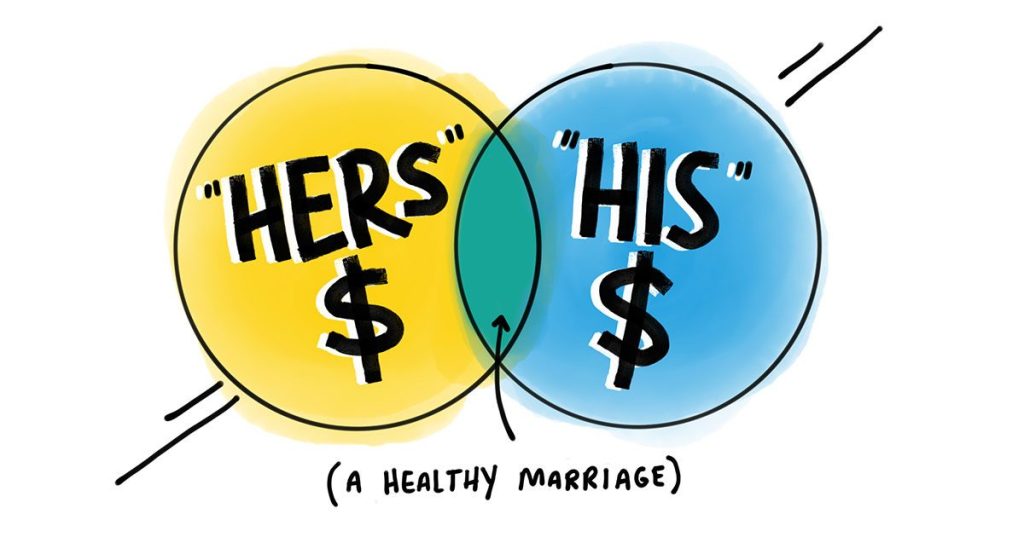
    We’re sharing our lives, so sharing our finances was a natural step. It keeps us aligned, transparent, and moving in the same direction. We love how we work so well as a team, and because we don’t really have stressful arguments about money, our love for each other blossoms even more over time.

    We use Empower (formerly Personal Capital) to track all of our accounts. It’s completely free, or at least we use the free version. You can link every category of your personal finances – credit cards, bank accounts, investment and retirement accounts, car loans, and mortgages, and the app or website gives you a complete view of your net worth, assets, and liabilities. Since we share all our accounts, there are no surprises that might cause a heart attack. Although… I’m still waiting for my husband to admit he has a secret stash of money somewhere. Wouldn’t that be nice? Don’t worry, babe, I promise I won’t be mad!😃

    Mutual respect = no power play

    No “I make more” energy, no scorekeeping. We value each other’s needs (and our families’ needs) equally – that’s real partnership. Every time we let each other know we’re about to make a purchase over (or way over) $50, the other person almost always says, “Sure, go ahead,” because the respect we have for each other comes with 100% trust.

    Once in a while, we have a dedicated conversation just about money. We review our current financial picture, income trajectory, investments, and the kids’ education fund. We also dream about the day when work becomes optional and we can FAT FIRE – that is, retire early while still living comfortably. Coming from humble backgrounds, these conversations bring us even closer.

    Every marriage is unique, and what works for ours might not work for yours. But one thing is clear: open communication, mutual respect, and shared financial goals can make a world of difference. What “secrets” or strategies for financial success in marriage have worked for you? We’d love to hear your insights and tips – let’s keep the conversation going!

  • What Motivates You to Save Money?

    What Motivates You to Save Money?

    Saving money is one of the most powerful steps toward building real wealth. While “saving” might sound dull or restrictive, it doesn’t have to be—especially when you have the right motivations behind it.

    A penny saved is a penny earned.

    I first came across this quote by Benjamin Franklin in my early twenties—though his original words were phrased a little differently. At the time, I had just finished grad school and was earning $45,000 a year. A pay raise felt like a distant dream. The only immediate way to see more money in my bank account was simple: save what I earned.

    But here’s the thing—our brains don’t naturally want us to save. There’s science behind that. We’re hardwired for comfort and instant gratification, not for delayed rewards. Corporations understand this all too well. They make spending frictionless: one-click checkouts, instant payment systems, and same-day delivery—all designed to help you part with your money effortlessly.

    As a twenty-something, of course I loved shopping too. I spent many afternoons walking through Center City Philly, browsing boutique stores on my days off. Luckily, Ben Franklin’s quote kept me in check and helped me build a habit of saving early on. I did plenty of window shopping and stayed up to date on fashion trends, but I learned to pause before buying. Every time I stopped to ask myself, “Do I need this, or do I just want it?”—I was training my financial discipline.

    And here’s a small but important tip: if you buy something new and change your mind after a few days, return it. It might sound obvious, but you’d be surprised how many people let new purchases sit unused, tags still on, until it’s too late. Taking advantage of return policies isn’t just about getting your money back—it’s about respecting the value of your hard-earned cash.

    As James Clear once said in his book Atomic Habits, “You should be far more concerned with your current trajectory than with your current results.” That mindset kept me going. Even when my savings seemed small, I knew I was moving in the right direction.

    More money saved = more can be invested.

    Albert Einstein once said, “compound interest is the eighth wonder of the world”. He wasn’t exaggerating. If you save $500 a month, that adds up to $6,000 a year—or $180,000 over 30 years.

    But here’s where it gets exciting: if you take that same $500 each month and invest it in a mutual fund averaging a 10% annual return, after 30 years you’d have $986,964—almost a million dollars! That’s the magic of compounding.

    Understanding how money saved and invested can snowball over time is one of my biggest motivations to save. Each dollar set aside isn’t just a dollar—it’s the seed of future growth. Knowing that if I choose not to spend a $20 bill today, it could become $25 just a few years later (at a 10% return, that’s about 2 years and 4 months) keeps me encouraged to save more—and to start now.

    Looking back, I’m grateful I learned the value of saving early. In my twenties, it wasn’t always easy to say no to things I wanted in the moment, but those small decisions added up. Each time I chose to save instead of spend, I wasn’t just growing my bank balance—I was shaping my mindset. Over time, saving stopped feeling like a restriction and started feeling like empowerment. It gave me confidence, freedom, and a sense of control over my future. And even now, years later, that same motivation—the one that started with a simple Ben Franklin quote—still reminds me that every dollar I choose to keep is a quiet investment in my future self.

    What motivates you to save? Share your thoughts in the comments—I’d love to hear your story.

  • Paying for Kids’ Education: 529 Basics You Need to Know

    Paying for Kids’ Education: 529 Basics You Need to Know

    My husband and I opened a 529 account for our son soon after his birth. Like many parents, we dream of him earning a full-ride college scholarship, but we’re realists at heart. Planning for his education means setting up a solid financial foundation now. That’s why we chose a 529 plan, drawn to its powerful tax benefits: tax-deferred growth and tax-free withdrawals for qualified expenses like tuition, books, and room and board.

    We also explored prepaid tuition plans, which let you lock in today’s tuition rates for future attendance at select colleges—a smart option worth considering. Ultimately, we chose a 529 investment account for its unbeatable benefits: tax-deferred growth, tax-free withdrawals for qualified expenses like tuition and books, flexible investment choices, and versatile withdrawal options. 

    Why should you look into a 529 Plan?

    With the rising costs of higher education and many Americans burdened by student debt, parents are increasingly using 529 savings plans, which offer tax benefits, to save for their children’s education. These plans, named after Section 529 of the Internal Revenue Code, were initially created to help cover college and other postsecondary education expenses.

    Tax Advantages

    • Investments in a 529 plan accumulate earnings without federal taxes (no taxes on gains or dividends) in the interim, enabling your savings to grow more rapidly through compounding since there’s no tax owed on ongoing investment returns or capital gains.
    • Withdrawals remain federally tax-free when applied to eligible education costs—such as tuition, textbooks, classroom materials, and housing and meals—although using funds for K-12 schooling could incur state taxes in some cases (check your state policy).
    • While contributions to a 529 are made with after-tax dollars so they’re not federally tax deductible, many states offer state income tax deductions on contributions or state tax exemptions on withdrawals if you invest in your own state’s 529 plan or if you live in a “tax parity state” (Arizona, Arkansas, Kansas, Maine, Minnesota, Missouri, Montana, Ohio or Pennsylvania) that allows you to deduct contributions to out-of-state plans as well.
    • In 2025, you can generally contribute up to $19,000 annually ($38,000 for couples) per beneficiary to one or more 529 college savings plans without triggering the federal gift tax. Alternatively, you can make a lump-sum contribution of up to $95,000 ($190,000 for couples) in a single year, treated as spread over five years for tax purposes, without incurring the federal gift tax.

    The Beneficiary Can Be Your Child, Your Grandchild, or Yourself

    • You can change the beneficiary to another child or family member if it turned out the original beneficiary doesn’t need the funds. As the account owner, you maintain control of the funds and have flexibility in how they are invested.
    • You can even open up a 529 account for yourself before you have children and later change the beneficiary to your child/children. The longer you have money invested in that 529 account, the longer period of time the investment can grow tax free.
    • Starting in 2024, you can roll over unused 529 funds into a Roth IRA tax- and penalty-free, but only to a Roth IRA owned by the same person who is the 529’s designated beneficiary. The 529 plan must also have been established for the beneficiary for at least 15 years before the transfer.

    Things to Watch Out For:

    • Don’t overfund your kids’ 529 plan(s). Withdrawals that are not for eligible education costs are subject to taxes plus a 10% penalty, with exceptions for certain circumstances, such as after death or disability. Utilize a compound interest calculator to project the growth and earnings of a 529 plan for a specific target year when college (or k-12) expenses are expected.
    • While the current federal law allow tax-free 529 withdrawals for K-12 tuition and certain expanded expenses (up to $10,000 per beneficiary per year in 2025, increasing to $20,000 in 2026), there are 11 non-conforming states that treat K-12 withdrawals as non-qualified distributions and will tax on earnings for k-12 withdrawals or even impose penalties. Review your state’s 529 plan rules to optimize your savings strategy and determine the most effective approach for your needs.

    Bottom Line:

    A 529 plan is a great estate-planning tool that could be used to save for education expenses while offering tax advantages and flexibility. For your child’s next birthday party, consider requesting contributions to their 529 education fund in lieu of traditional gifts to support their future academic goals.

    Have you started a 529 plan? Share your tips in the comments!

  • 6 Tips to Lower Your Taxes

    6 Tips to Lower Your Taxes

    One of Benjamin Franklin’s most famous and often-cited quotes is, “In this world, nothing can be said to be certain except death and taxes.” While paying our fair share of taxes is essential to keep public schools funded, roads maintained, and parks and recreation services operating smoothly, it’s equally important to be smart about tax savings. By doing so, we can ensure that our hard-earned dollars help us maintain a higher quality of life. Here are some practical and legal tax-saving tips specifically for regular W-2 earners (employees who receive a paycheck with taxes withheld).

    1. Max Out Employer-Sponsored Retirement Accounts

    Retirement Accounts such as 401(k), 403(b), or TSP are some of the most effective ways to save on taxes while building long-term wealth. For any of these accounts, you can contribute either to a Traditional account or a Roth account. Take 401(k) as an example:

    Traditional 401k: A Tax Break Right Now

    Contributions are made with pre-tax dollars, which lowers your taxable income and reduces the amount of income tax you owe today. The money you invest then grows tax-deferred, meaning you don’t pay taxes each year on interest, dividends, or capital gains—allowing your savings to compound faster.

    Roth 401k: A Tax Break in Retirement

    While a traditional IRA offers an immediate tax deduction, a Roth IRA provides its benefits later—during retirement. Because contributions are made with after-tax dollars, both your investment growth and withdrawals are completely tax-free in retirement. This can be a major advantage for younger investors in their 20s or 30s, as it allows decades of potential tax-free compounding throughout their careers.

    Look into Employer Matching

    Many employers also match contributions, adding extra, tax-advantaged money to your account. In retirement, withdrawals are taxed at your ordinary income rate, which for many people is lower than during their working years, making the 401(k) a powerful tool for both tax savings and financial growth.

    2. Max out IRA

    Not everyone has a 401(k), but everyone can open up an IRA account. Similar to an employer-sponsored retirement account, you can elect to contribute either to a Traditional IRA or a Roth IRA, and your contributions will be tax deductibles. The amount you are eligible to contribute depends on factors such as your income level and whether you or your spouse are covered by a workplace retirement plan. For instance, in 2025 (for taxes filed in 2026), if you’re married filing jointly, covered by an employer plan, and your modified adjusted gross income is $146,000 or higher, your deduction may be limited or unavailable. Contribution limits also apply — for 2025, you can contribute up to $7,000 annually, or $8,000 if you’re age 50 or older. Additionally, you have until the tax filing deadline to make IRA contributions for the previous year, giving you extra flexibility to maximize your tax benefits.

    3. Take Advantage of Pre-Tax Benefits

    Health Savings Accounts (HSAs) and Flexible Spending Accounts (FSAs) both help you reduce your taxable income by putting money away for healthcare expenses. 

    Health Savings Account (HSA): Available if you have a high-deductible health plan.

    Contributions are tax-deductible, grow tax-free, and can be withdrawn tax-free for medical expenses. The HSA contribution limits for 2025 are $4,300 for self-only coverage and $8,550 for family coverage. Those 55 and older who are not enrolled in Medicare can contribute an additional $1,000 as a catch-up contribution.

    Flexible Spending Account (FSA): Use pre-tax dollars for medical or dependent care costs.

    Contributions are taken from your paychecks directly and put away in the FSA account, so you don’t pay taxes on them. The Health FSA contribution limits for 2025 are $3,300 per year, with a $660 rollover maximum. Dependent Care FSA contribution limits for 2025 are $5,000 per household (married filing jointly).

    4. Adjust Your Withholding

    The W-4 form is a form you fill out to tell your employer how much tax to withhold from each paycheck. Review your W-4 form each year or after major life changes (marriage, new baby, home purchase) to make sure you are withholding the right amount based on your tax estimates. You don’t want to over-withhold: while a big refund is nice, you would be giving IRS an interest-free loan while missing out time in investment. You also want to be careful and not under-withhold: you’ll end up with unexpected tax bill when you file your return and may be subject to an underpayment penalty.

    5. Look Into Tax Credits You May Qualify For

    Tax credits are one of the most powerful ways to reduce your tax bill because, unlike deductions (which lower your taxable income), credits directly reduce the amount of tax you owe — dollar for dollar. Popular tax credits include:

    Tax Credits for low-to-middle-income households

    Earned Income Tax Credit: The rules can get complex, but if you think you’ll earn less than $68,675 in 2025, the earned income tax credit might be worth looking into as it could get you up to $8,046 when you file in 2026.

    Premium tax credit is another refundable tax benefit that is worth looking into. It can help offset the cost of health insurance premiums from qualified health insurance marketplace plans.

    Child Tax Credit

    The child tax credit could get you up to $2,200 per kid, with $1,700 being potentially refundable through the additional child tax credit. You may qualify for the full credit only if your modified adjusted gross income is under:

    • $400,000 for those married filing jointly and $200,000 for all other filers.
    • The higher your income, the less you’ll qualify for.

    Lifetime Learning Credit

    The lifetime learning credit can get up to $2,000 (per return, not per student) for tuition, activity fees, books, supplies and equipment for undergraduate, graduate or even nondegree courses at accredited institutions.

    6. Kids’ 529 with Triple Tax Advantages

    While it would be everyone’s dream that their kids would get a full ride scholarship to their dream colleges, it would be wise to still plan realistically and take advantage of the tax benefits of 529 accounts.

    • While 529 contributions are after-tax dollars, some states offer state income tax deductions or credits for contributions to your kids’ 529 accounts. Check your state and see if there’s any tax incentive.
    • Contributions in 529 accounts grow tax-free – You won’t pay taxes each year on interest, dividends, or capital gains — the money compounds without any taxes.
    • Withdrawals are tax-free when used for qualified education expenses. This includes tuition, books, fees, supplies, and even room and board for college. You can also use up to $10,000 per year for k-12 tuition and up to $10,000 total toward student loan repayment. You can also change the beneficiary to another family member or even yourself without triggering taxes.

    A quick reminder: if you use 529 funds for non-qualified expenses, only the earnings portion (not your contributions) will be subject to income tax plus a 10% penalty. To plan wisely, it’s a good idea to use a compound interest calculator to estimate how much you’ll need to invest today to cover your child’s education costs when the time comes.